Behold. My trusty painting apron!
A physical metaphor for something we often forget...
Creativity is messy!

I seldom need my "painting armour" in the convergent phase.
Controlled. Deliberate. Critical…
But the divergent phase is something else entirely.
Free. Uninhibited. Expressive. Energetic. Exploratory…
Ah, this is that lovely, messy place where ideas are born! And for an idea to live, it must first be born…
Because creativity isn't neat. It doesn't happen in clean, controlled spaces. Not in those awfully clever corporate innovation rooms with indoor astroturf, colourful beanbags, and pristine whiteboard-painted walls everyone is too afraid to touch...
Creativity happens in the chaos of exploration. In trial and error, and in the willingness to embrace uncertainty.
These are the habits I keep coming back to in my visual thinking work.
Messiness is not a byproduct of creativity...
It is the process!
"The olive tree is surely the richest gift of heaven."
Pliny the Elder
In my garden on a mountain slope in Cape Town grows an unruly olive tree.
Planted by the original owners of our home back in 1948, for the past 78 years it has stretched upward, unpruned and untrained, as it tries to outcompete an enormous yellowwood and wild fig, to reach the golden Cape Town sun.
Most of the olives are beyond our reach. But every year, my family and I manage (with great effort) to pick and prepare up to 10kgs of olives.

The olive is one of the oldest and most sacred fruits in human history.
Revered in ancient Greece, the olive tree was a divine gift, symbolising wisdom and peace. Homer called olive oil "liquid gold," recognising both earthly value and divine essence.
In the Bible, the olive branch becomes the ultimate sign of reconciliation, the dove returning to Noah with a leaf in its beak marks the end of destruction and the beginning of new life. Olive oil, too, played a sacred role: for consecration, the anointing of kings, and the healing of the sick.
Yet the olive, in its raw state, is so bitter that it is inedible. Pluck one from the tree and taste it… it is sharp, bitter, even hostile...
Before it can be eaten, it must first undergo brining in salt water, a slow, deliberate leaching of bitterness, a fermentation that cures and transforms the olive into something flavoursome, complex and nourishing.
This process can take weeks or months. The olive is cut or cracked to allow the salt water to enter, and then submerged.
Life exposes us to suffering, disappointment, pain, trauma, anger, disillusionment, and the sting of betrayal. And in response, we often carry bitterness… resentments, remorse, regret…
Transformation demands brining.
Forgiveness, surrender, immersion, healing, grace…
...before the fruit can come to the table.
Slides are built to be clicked past. Hand-drawn visuals are made to be remembered. When ideas are captured live, in real time, in words and images together, people engage with them differently. People get excited, they respond, they point. And they recall it weeks, sometimes years later. That difference is the heart of visual thinking, and it is why a single drawing can carry more weight and meaning than a deck of forty slides.

We have all sat through those polished-but-forgettable presentations. The slides advanced, the bullet points appeared on cue, and by the time everyone reached the car park at the end of the day, the content had already faded. The issue is rarely the information. It is the format. A slide delivers content. It asks you to passively receive. A drawing asks you think.
There is a simple reason images outlast bullet points. Our minds hold pictures and words in different places, but when the two arrive together they reinforce each other. Researchers call it dual coding. You do not need the term to feel the effect. Think of the idea that stayed with you. The odds are good it had a shape, a metaphor, or a image attached to it... not just a sub-point on slide twelve.
A hand-drawn visual also carries something a template cannot replicate, and that is attention. When people see their ideas taking shape before them, they engage with them differently. The drawing becomes proof that the conversation mattered, and that proof is far more persuasive than polish.
Visual thinking is the practice of working ideas out on the page rather than only in one's head. It uses a combination of directional arrows, containers, icons, and a few well-chosen words to make ideas visible. The thinking is externalised so it can be examined, questioned, shaped iterated, and built on. It has very little to do with being able to draw well. It has everything to do with getting everyone on the same page (quite literally), so that a group can all see the same picture and think with it together.
Done live, visual thinking turns a meeting from a series of monologues into a shared act of sense-making. The page becomes a third presence in the room, holding the connections that a spoken conversation loses the moment the next person starts talking. Nothing is left to the air. It is all there, in front of everyone, ready to be moved, challenged, and connected.
It is tempting to treat visuals as that superficial, pretty layer you add at the end. But in practice, the drawing is where the thinking happens. Drawing is thinking. The act of deciding what goes on the page, what to leave out, and how ideas connect forces a clarity that cannot be found in words alone. The visual does not lie. If the logic does not hold, it becomes immediately obvious.
This is why Visual Thinking surfaces problems early. The gaps, the leaps, and the unspoken assumptions are all evident the moment you try to draw them. Far from being merely decorative, a visual is one of the fastest, most honest tests of an idea. It allows mistakes be made on paper rather than out in the real world
This is what Graphic Recording, as a subset of Visual Thinking, brings to a strategy session, a workshop, or a keynote. Instead of prettier notes, the room gets a shared visual memory: a live drawing that captures the conversation as it unfolds and gives everyone a single picture to think against. The work I do as a graphic recorder is visual thinking applied to other people's conversations, in real time and at scale.
Picture a leadership team trying to agree on strategy. Everyone is talking, good points are made, and an hour later the same questions come round again because nobody can see the whole shape of the discussion.Now imagine that evolving conversation made visible on a wall. The themes cluster, the tensions become visible, and the group can finally point at the thing they disagree about. What people take out of the room is not just notes, but a simple, navigable, high-level visual synthesis of the thinking they can return to again and again.
You do not need to be an artist to start. A few simple habits go a long way:
Try it in your next meeting with nothing more than a marker and a large sheet of paper, or a whiteboard. Resist the urge to make it neat. Clarity over perfection. The goal is not a beautiful picture, it is a clearer conversation, and from that the quality of everything else becomes visible.
A slide is built to be clicked past. A hand-drawn visual is built to be remembered, because it doesn't only present ideas, it helps people to think them through together. That is the power of visual thinking, and why, long after the deck is closed, the drawing is still on the wall.
If you are planning a session, a workshop, or an event where the thinking really matters, live graphic recording is built for this. Take a look at how it works, or get in touch to talk through what you have in mind.
To sit in the question is to resist the urge for immediate answers and instead dwell in uncertainty with curiosity. It’s a deliberate act of patience. A willingness to hold space for ambiguity and let a question breathe, evolve, and shape your perspective over time.
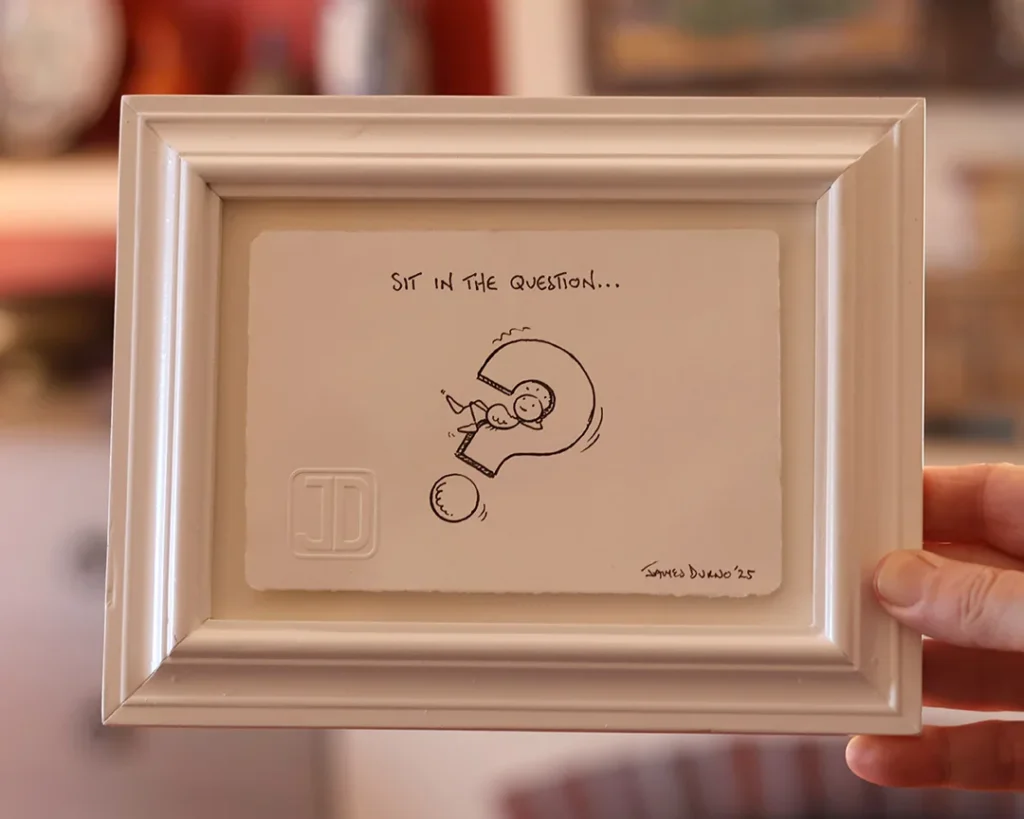
This can feel uncomfortable, as we are wired for quick solutions. But some questions are too big, too complex, too layered, too alive, to be resolved at once. They ask us to slow down, pause, and listen deeply.
Sitting in the question isn’t passive. It’s an active, reflective stance. A posture of openness. It means letting a question travel with you… and challenge you. In that quiet tension, insight often emerges without being forced.
To sit in the question is a core part of visual thinking. It is the space where insight begins to take shape, before the edges are defined and the lines are drawn. As a visual communicator, it means resisting the urge to resolve too quickly and instead allowing the question to unfold visually, spatially, and emotionally.
Some questions don’t need immediate answers. They need to be viewed from different angles, mapped out, navigated, and experienced. Sitting in the question invites curiosity over certainty. It’s an active pause, and a chance to observe patterns, hold tensions, and explore connections that may not be obvious at first glance.
This posture of openness is what allows deeper understanding to emerge. Not everything can or should be made clear right away. Sometimes, clarity is the result of staying with complexity long enough for form and meaning to surface…
And in that space… in the margins, in sketchbooks, on whiteboards, in visual conversations, the answers and solutions gradually come into focus.
To sit in the question, then, is not a delay in the creative process…
It is the Process.
In Visual Thinking, a question isn’t just a prompt… the question is a frame.
Visual Thinking is the art of both thinking and seeing differently.
A question can shape the canvas of our ideas, set the perspective, and define the edges. It can determine both what we focus on and what we ignore. A well-formed question can challenge the composition of our perceptions. It can draw attention to the negative space, shift the focal point, or flip our thinking.
Questions can subtly (or unsubtly) guide how a problem is perceived. Is it open or closed? What assumptions does it carry? Is it looking to fix, or does it seek to understand? Like the edges of a canvas, a question creates boundaries… but also possibility. It can widen or narrow our view.
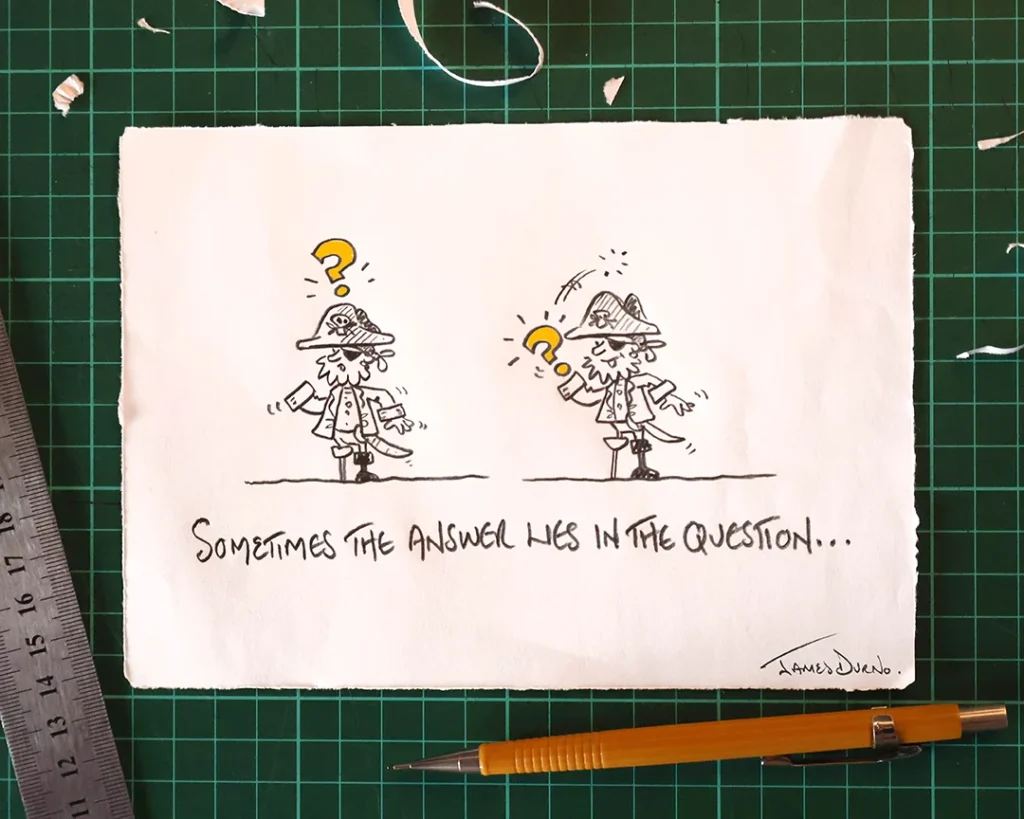
We tend to rush to answers (at least I do 😄 ). We want immediate clarity, solutions, action and direction.
But sometimes a good question causes us to pause long enough to notice what has been there all along.
It shifts the angle of cognition, allowing for lateral thinking and oblique perspectives. It makes space... It changes the light....
The ability to surface underlying assumptions, to reframe a challenge, or to redraw the boundaries of a conversation can be more powerful than any immediate solution. It’s not always about having the right answer. Often, the most valuable insights come from what the question uncovers, rather than what we add.
Sometimes it’s about holding the right question… and holding it long enough for something deeper to emerge…
Once, there was a kite who loved to fly.
Each day, it soared high above fields and rooftops, dipping and dancing in the wind. Children below marvelled at the bright colours, its grace and joy.
But… as the kite twisted and turned through the boundless, beautiful, big, blue sky, it began to resent the string that held it.
"If only I were free," thought the kite, "I could go anywhere I wanted. I could fly higher than ever before, without anyone holding me back."
The string tugged gently, a steady, guiding tension. But the kite saw it as a chain.
One day, catching a powerful gust, the kite strained with all its might and SNAPPED the string!
For a moment, it was exhilarating. The kite soared, wild and weightless. "At last, I’m truly free!" it cried.
But then the wind shifted…
Without the string to steady it, the kite was directionless. The breeze, once a playful partner, had become a raging gale. The kite, now lost and helpless, was tossed and tumbled like a leaf.
And finally, it fell, caught in the branches of a tree. Tangled and torn.
Then, the kite understood.
It was the string that had given it flight. That limiting tether it so resented was its lifeline: the very thing that gave it the freedom to dance with the wind.
Freedom without boundaries is not freedom at all.
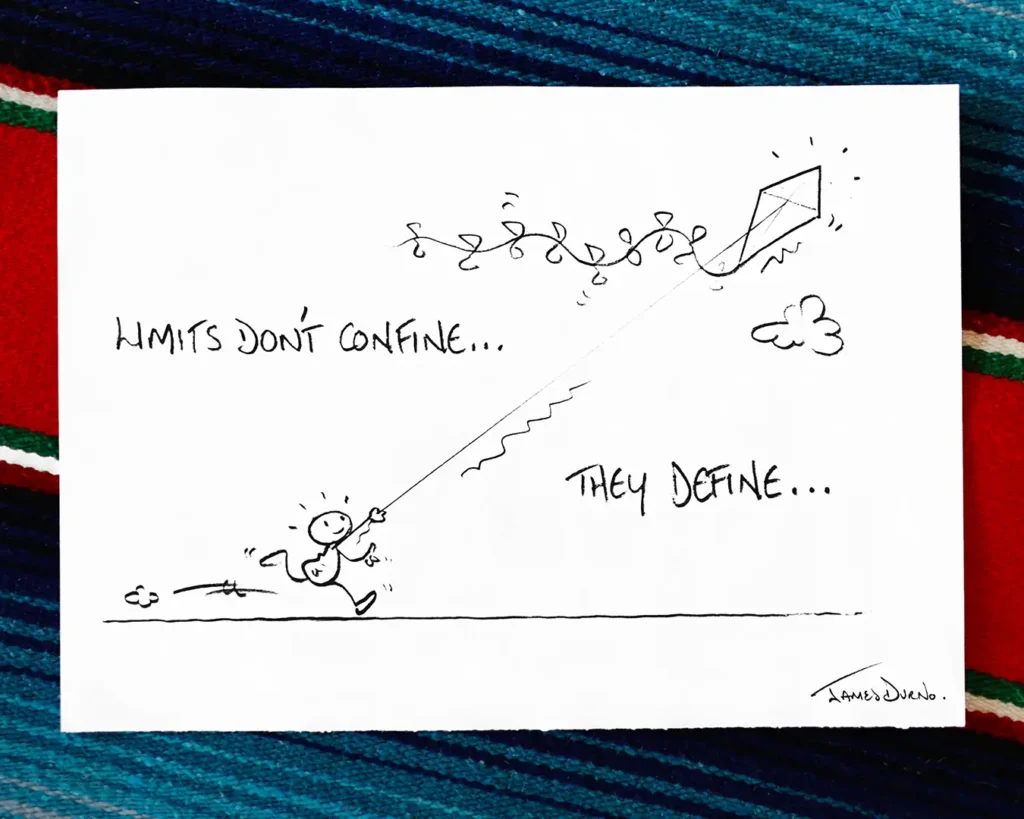
Limits don’t always confine. Sometimes they define.
We often think of freedom as the absence of boundaries, the unshackled self, soaring unimpeded through wide, open skies. But true freedom is rarely found in boundlessness. It is not the absence of constraints, but the presence of purpose, of discipline, of something to tether us.
Imagine a kite, high above the earth, riding the sky.
From the ground, it appears free: gliding, climbing, swooping with effortless grace. But the secret to its flight is not the wind alone. It is the string. That taut line connecting it to the earth is also what allows the kite to soar.
The string provides the tension between freedom and control, guidance and direction.
The kite may strain against it, feel it as a limitation, even dream of cutting free in pursuit of perceived freedom… one without rules and accountability.
But the moment the string is cut, it is the end of freedom. The wind, once a partner in play, becomes a chaotic force of destruction.
The string was never the enemy, but the very thing that made flight possible.
In life, like in flight, freedom and constraint are not opposing forces. They work in tandem. Constraints provide the parameters for creativity. Discipline sharpens potential. And accountability gives our actions meaning.
We live in a world that romanticises, even glamourises, spontaneity and rebellion. We are encouraged to break free, to live unbound, to follow only our desires, to cast off restraint.
But a life without boundaries becomes a life without form. We run the risk of disorientation, chaos, and the slow erosion of purpose.
Limits don’t always confine. Sometimes they define…
In the 1964 movie, Mary Poppins, to the children’s delight and amazement, pulls a series of impossibly large items – a standard lamp, a potted plant and a coat stand - from her carpet bag…
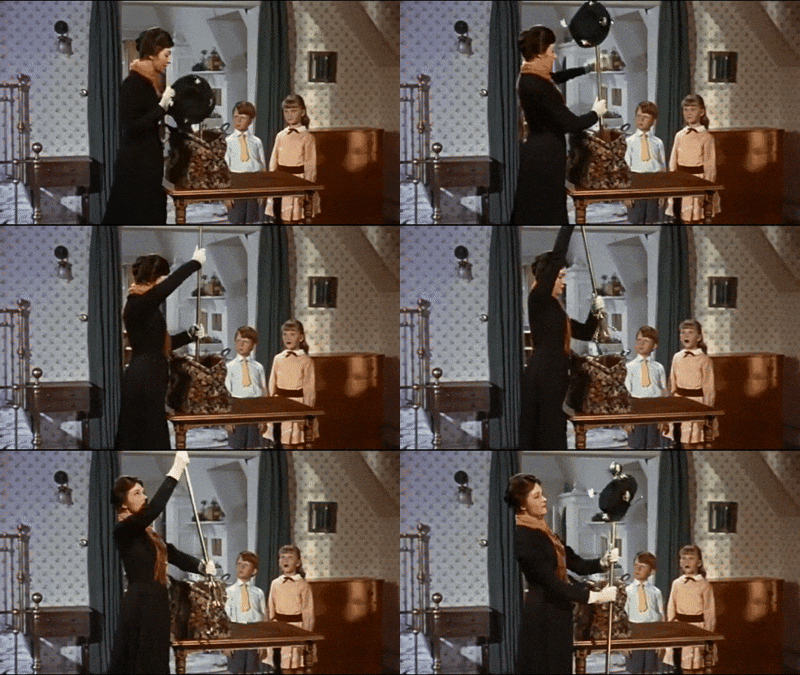
I first saw the movie ten years later, in 1974, when I was just six years old. Fast-forward a few decades, and I am now a grown-up Visual Communicator. Which means I’m an Artist, Graphic Recorder and Business Illustrator. My task is to make the complex simple by collapsing ideas into simple and accessible visuals.
But simple isn’t easy.
Which brings me to my point.
What is the value of a picture?
A picture doesn’t simply unpack an idea – in fact, it does quite the opposite. A well-crafted visual packs ideas for the unpacking.
Like Mary Poppins’ Carpet Bag, a powerful visual can hold ideas that are much bigger than the picture itself. It too is paradoxically bigger on the inside than it is on the outside.
A strong visual captures, synthesises, sorts, sifts, collapses, “zip-files” and succinctly communicates. It distils, compresses, organises, clarifies and simplifies complexity. It speaks powerfully, even eloquently.
Whatever the visual process or visual device, whether it be a visual metaphor, design thinking, rich picture, drawing, painting, visual narrative, mind map, roadmap, graphic recording, or sketchnote – Pictures communicate. Powerfully.
A Drawing holds and carries meaning. It is a bespoke container, crafted to carry an idea. In many respects, it is the proverbial box reimagined.
The process of simplification, collapsing and distillation does not reduce quality and potency. On the contrary. The process of simplification creates a powerful concentrate, and gravity and potency are multiplied.
So, what is the value of a picture?...
Perhaps we should be asking, “what is the value of a clearly articulated Vision. Or a well-communicated Strategy?”
This is the Power of Visual communication. This is the Power of Visual Thinking.
Why, it’s Supercalifragilisticexpialidocious!
If you have a Vision or a Strategy that deserves to be packed well and unpacked powerfully, that is exactly what I do. See how live graphic recording works, or get in touch.
Recently, I had the great pleasure of hosting a Cape Town CEO at my studio for a one-on-one Visual Conversation.
We started with a Brain Dump on a large whiteboard. A perfect erasable medium for a shifting and organic conversation.
We then moved to working with paper cutouts on my V3 Neuland Graphic Wall. Instead of post-its, we worked with multiple photocopied “platforms” drawn in oblique perspective.
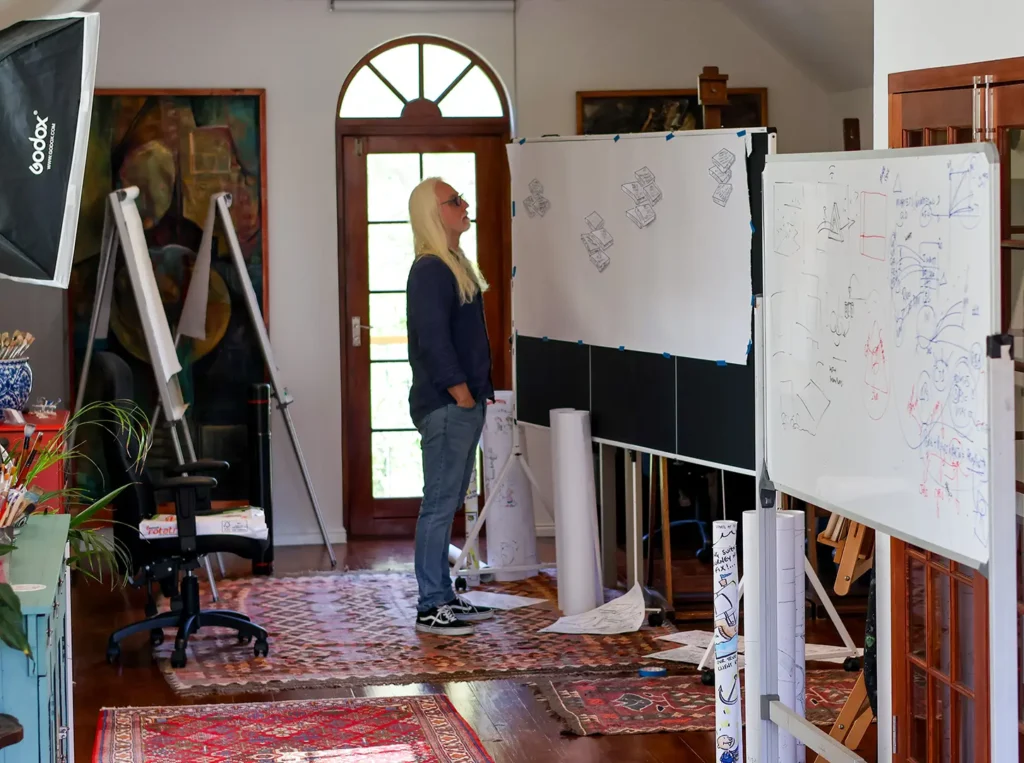
Because they are drawn in perspective, and have a top and sides, I can add a title or descriptor to the side edges. The surface plane can hold the content or the idea. The perspective also breaks the picture plane and gives one a sense of working in navigable space.
We were able to break down the complexity of the content, identify the component parts, group and assemble (and reassemble) relative to each other.
I drew very little, and most of my visual notes were drawn separately on another surface.
After a couple of hours, we had broken through the noise and clutter.
We can now begin to visualise, populate and illustrate the detail...
A Visual Conversation takes place in the space between us.
It is quite literally “getting on the same page.” It is collaborative and co-creative.
It is pushing and pulling, diverging and converging, breaking apart and reassembling, pulling back and zooming in, to reach simplicity, clarity and consensus.
This is the value of a Visual Conversation. This is the Power of Visual Thinking.
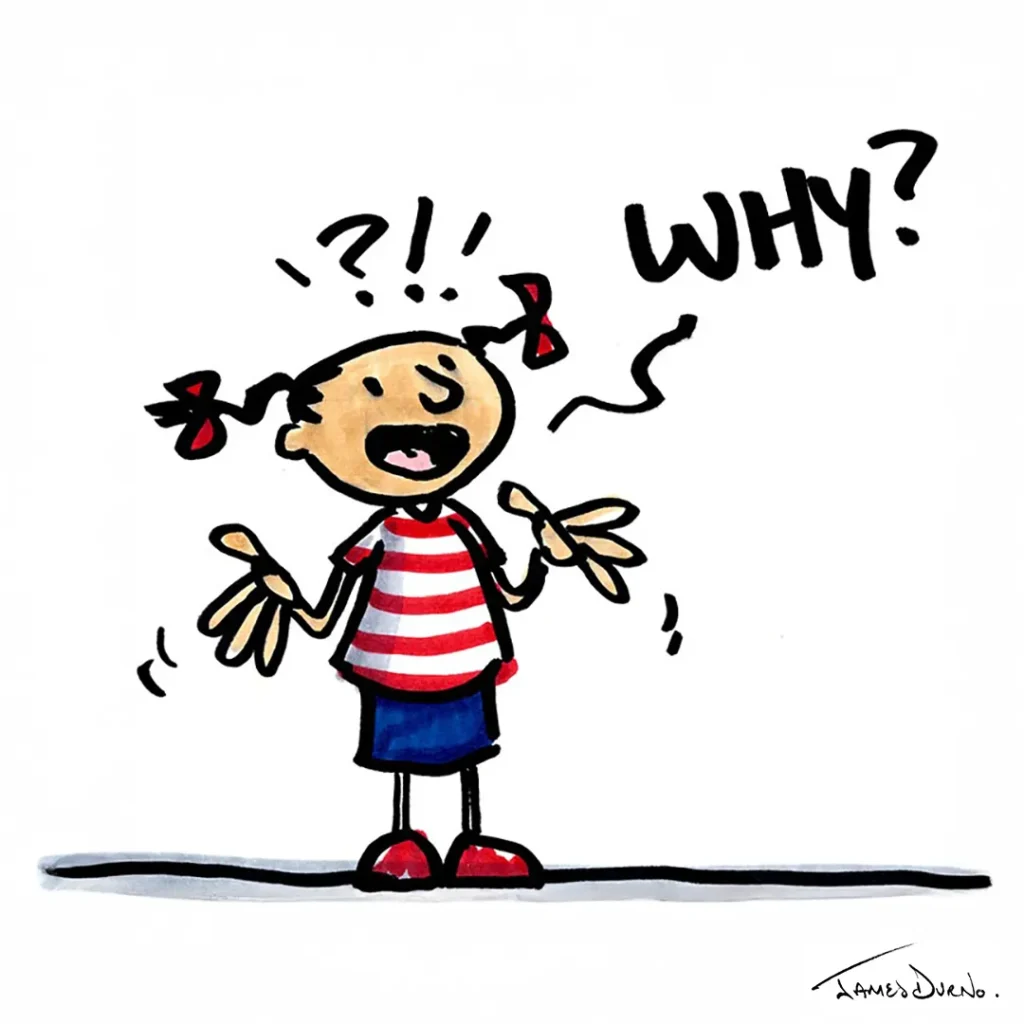
The greatest innovators are those who don’t just think outside the box - they question why the box exists at all.
And sometimes, reimagining the box is just the genius of not knowing what’s impossible…
Intelligent naïveté is wonder wearing spectacles. It is a blend of childlike curiosity and informed
awareness. It’s the ability to question assumptions, see with fresh eyes, and explore ideas without being limited by the way things have always been done, whilst still drawing on experience and critical thinking. It has the audacity to imagine better while carrying the weight of experience lightly.
Why is it done this way?... What if we tried something different?... Why not?...
It is one thing that artists, scientists, entrepreneurs, and children have in common - the audacity to ask questions that no one else is asking.
It is purposeful curiosity and an open, unconditioned perspective.
A willingness to suspend disbelief long enough to explore better possibilities.
It is the “what if?” that sets stagnant waters rippling.
Intelligent Naivete challenges norms… Sees possibility… Finds doorways in walls others walk past… It dares to wonder…
Breakthroughs belong to those wise enough to learn — and naïve enough to question…
Let’s not grow so wise that we forget how to wonder.
So…What is your Why?..
AI promises speed and simplicity - but in outsourcing thinking, creativity, and visual communication to algorithms, we risk losing the human nuance behind meaning-making. Like a high-interest credit card, the convenience comes with a hidden cost: loss of expertise, ethical erosion, and the atrophy of true creative practice.
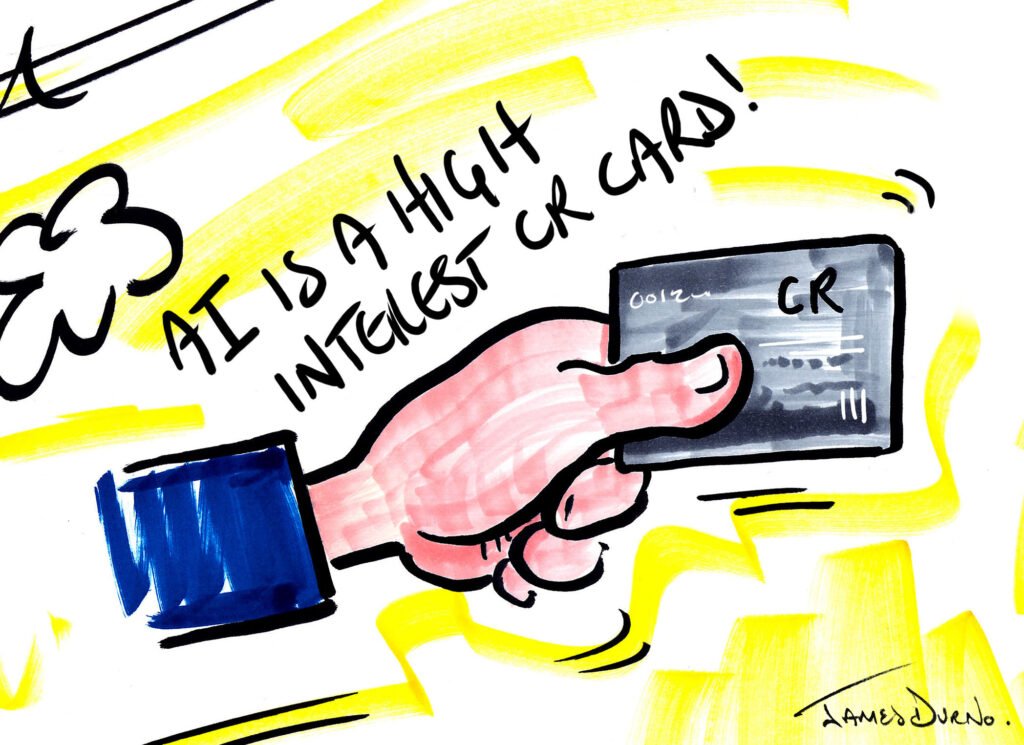
AI is mind-blowing. When I studied fine art back in the 80s, the idea that a machine could generate a credible artwork, mimic a voice, or eloquently write on demand would have felt like pure science fiction. The possibilities AI unlocks seemingly endless.
However…
AI is like a High Interest Credit Card, and it seems we are swiping faster and faster, with reckless abandon…
… Generating content, automating our decisions, offloading tasks… outsourcing our thinking and creativity for the sake of speed and efficiency…
AI offers speed, ease, and tempting shortcuts, but the cost is quietly compounding, and the interest is high… There will be consequences…
As we outsource thinking, creativity, and judgment, we risk forgetting how to think, create, and discern for ourselves...
It feels like we are building an over-reliance on opaque systems we do not understand…
Fragile foundations - we prioritise quick wins over structural integrity... and that’s how cracks form - slowly at first, then all at once…
We allow algorithms to decide for us without questioning the assumptions or source. There is an ethical erosion as we mine the thought leadership of others and present it as our own expertise...
Like using credit to fund a lifestyle we can’t afford, AI simulates progress without us having to do the vital foundational work.
Interest accrues in the form of bias, skills stagnation, trust erosion and creative atrophy…
And eventually there will be a price to pay…
Obviously, I have a creative industries bias, as a Visual Communicator, Graphic Recorder and Artist, but ultimately there isn’t an industry that won’t be impacted by AI.
I’m not for a moment suggesting that we shouldn’t use AI, just that we use it wisely, thoughtfully and with our eyes wide open.
So, what are we borrowing against?
What are we surrendering for the sake of convenience?
And who will ultimately pay… and at what cost?...